News
Union Environment, Forest and Climate Change Minister Bhupender Yadav inaugurated the Lion Species Spotlight Programme at Sasan Gir, Gujarat, on 14 May 2026. It was a pre-summit event for the International Big Cat Alliance (IBCA) Summit 2026. The programme presented India’s Asiatic lion conservation experience and highlighted the need for cooperation among lion range countries.
Updates
- Event purpose: The programme examined the global conservation status of lions and India’s species-conservation measures.
- Conservation priorities: It focused on habitat pressure, climate change, human–wildlife interaction, knowledge exchange and capacity building.
- New resource: The event launched a Lion Conservation Brochure.
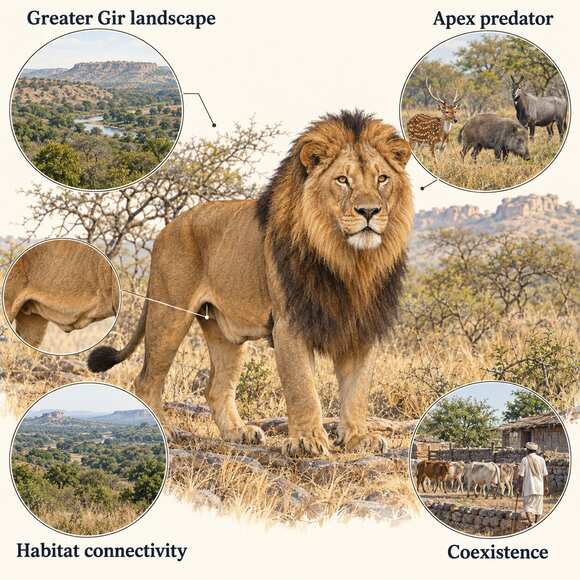
- Population estimate: The 2025 estimation recorded 891 Asiatic lions in the Greater Gir landscape. This was a 32% increase from 2020.
Why the Programme Matters
- India’s conservation model: It showcased the recovery of the Asiatic lion through protection, habitat management and community participation in the Greater Gir landscape.
- International cooperation: It promoted exchange among lion range countries on shared threats such as habitat loss, climate change and conflict with people.
- IBCA linkage: It created a species-focused platform before the IBCA Summit, which works for conservation of seven big cat species.
About the Asiatic Lion
- Wild range: The Asiatic lion is the only surviving wild lion population in Asia. Its free-ranging population occurs in Gujarat’s Greater Gir landscape.
- Protection: It is listed in CITES Appendix I and receives the highest protection under Schedule I of the Wildlife (Protection) Act, 1972.
About Project Lion
- Approach: Project Lion uses a landscape approach for habitat restoration, population management and ecological resilience.
- Need: It seeks to reduce risks from disease, fragmentation and the concentration of the wild population in one broad landscape.
About the International Big Cat Alliance
- Species covered: It works for tiger, lion, leopard, snow leopard, cheetah, jaguar and puma.
- Role: It promotes international cooperation, science, capacity building and conservation finance for big cat landscapes.