
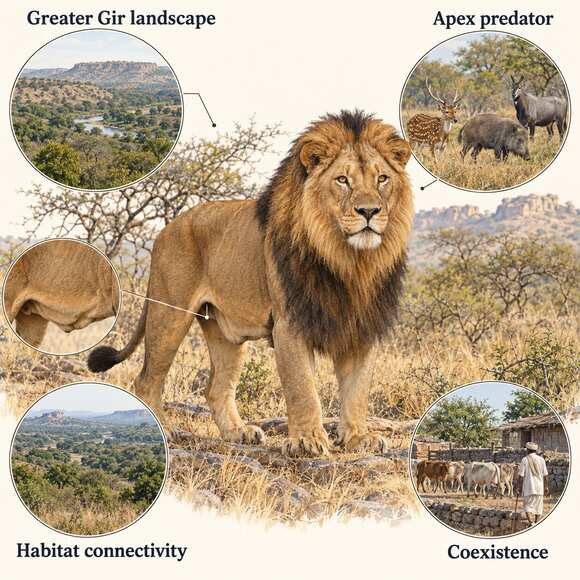
The Asiatic lion is the only surviving wild lion population in Asia. It occurs in Gujarat’s Greater Gir landscape, where dry deciduous forest, thorn scrub, grassland, agricultural land and coastal habitats form a connected conservation landscape.
Basic Details
- Scientific name: Panthera leo leo. The older name Panthera leo persica is still widely used for the Asiatic population.
- Distribution: Its free-ranging population occurs in the Greater Gir landscape of Saurashtra, Gujarat.
- Habitat: It uses dry deciduous forest, thorn scrub, grassland and human-dominated areas around protected habitats.
- IUCN status: The global lion assessment lists Panthera leo as Vulnerable. The Asiatic population needs separate landscape-level protection because it is concentrated in one region.
- Legal protection: The Asiatic population is listed in CITES Appendix I and receives the highest protection under Schedule I of the Wildlife (Protection) Act, 1972.
Distinguishing Characteristics and Habits
- Abdominal fold: A longitudinal fold of skin along the belly is a well-known field feature of Asiatic lions.
- Mane: Adult males usually have a less extensive mane than many African lion populations, leaving the ears more visible.
- Social hunting: Lions live in prides, but their group size and movements change with prey, water and habitat conditions.
- Apex predator: They regulate prey populations and influence the wider food web.
Ecological and Conservation Significance
- Flagship species: Lion conservation protects a wider dryland and forest landscape, including prey species, grasslands and corridors.
- Recovery example: Gujarat’s 2025 estimation recorded 891 lions, compared with 674 in 2020.
- Cultural value: The lion has a strong place in India’s natural heritage and public conservation awareness.
Major Threats
- Single-population risk: A disease outbreak, wildfire, cyclone or other disaster can affect a large share of the global wild population.
- Human-lion interaction: Expansion into farms, villages and coastal areas can increase livestock depredation and accident risks.
- Habitat fragmentation: Roads, railway lines, wells, fencing and development can disrupt movement and cause mortality.
- Genetic vulnerability: A historically small population needs monitoring for genetic diversity and disease susceptibility.
Conservation Initiatives
- Project Lion: India’s long-term programme focuses on habitat, corridors, prey, disease control, conflict mitigation and scientific monitoring.
- Landscape approach: Conservation extends beyond Gir National Park to the larger Saurashtra landscape where lions now range.
- Population security: The need for additional free-ranging populations remains important for reducing catastrophic risk.