
Project Lion is India’s long-term conservation programme for the Asiatic lion and the Greater Gir landscape. It treats lion recovery as a landscape challenge involving habitat, prey, disease management, corridors, local communities and scientific monitoring.
Basic Details
- Launched: The Government announced Project Lion in 2020.
- Nodal authority: The Ministry of Environment, Forest and Climate Change works with the Government of Gujarat and conservation institutions.
- Geographical focus: The programme focuses on the Greater Gir landscape and other suitable areas for securing the Asiatic lion population.
- Target species: The Asiatic lion is the only surviving wild lion population in Asia.
Need
- Single-range vulnerability: Most wild Asiatic lions occur in one broad landscape, creating high risk from epidemics and natural disasters.
- Growing human interface: Lion movement through farms, settlements and transport corridors needs planned conflict mitigation.
- Landscape change: Habitat fragmentation can reduce prey availability, safe dispersal and genetic exchange.
Core Features and Components
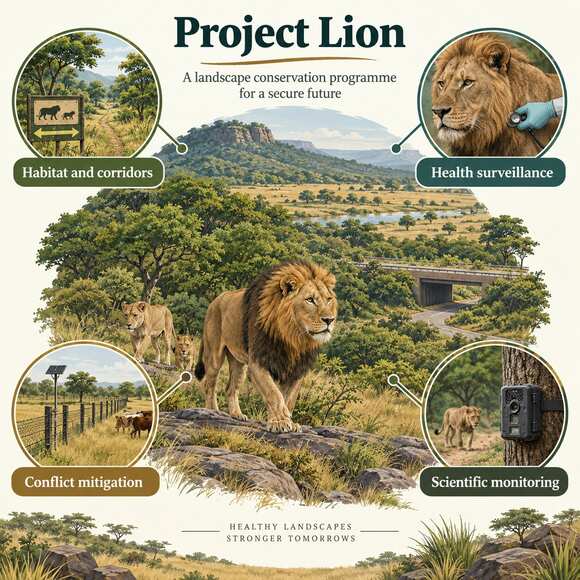
- Habitat management: It supports habitat improvement, grassland and water management, and protection of movement corridors.
- Scientific monitoring: Population estimation, radio telemetry, health surveillance and genetic assessment guide management decisions.
- Disease preparedness: Surveillance, veterinary capacity and response protocols reduce the risk of infectious disease outbreaks.
- Conflict mitigation: Compensation, awareness, rescue response and safer infrastructure aim to reduce harm to people and lions.
- Population security: The programme supports planning for additional secure populations and wider landscape resilience.
Significance
- Beyond protected areas: It recognises that many lions now use human-dominated landscapes outside Gir National Park.
- Risk reduction: It addresses disease, disaster and fragmentation together instead of relying only on anti-poaching measures.
- Conservation model: It links species recovery with community participation and landscape planning.