News
India launched its first-ever Guide to Grasslands and Other Open Natural Ecosystems of India at UNCCD COP17 in Ulaanbaatar, Mongolia. The guide treats grasslands and other naturally open landscapes as ecosystems in their own right. It moves away from the old view that such areas are merely “wastelands”.
Updates
- Launched at: The guide was released at the 17th Conference of the Parties to the UNCCD in Ulaanbaatar, Mongolia.
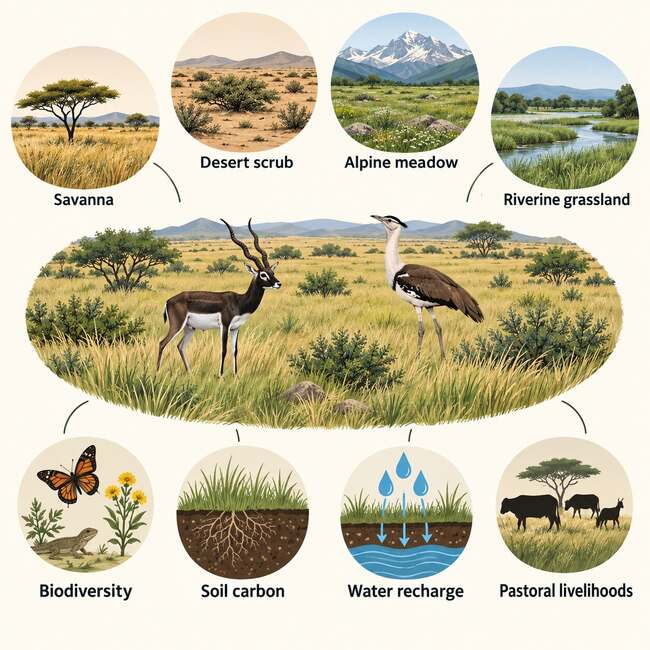
- Coverage: It brings together grasslands, savannas, deserts, scrublands, ravines and rocky plateaus in one national reference.
- Knowledge base: It records the geographical setting, ecological features, biodiversity and community links of major open natural ecosystems.
Major Features of the Guide
- Recognition of open ecosystems: It recognises tree-sparse landscapes as natural ecosystems. They should not be treated automatically as degraded forests or land waiting for plantations.
- Ecological processes: It covers issues such as pastoralism, fire ecology and soil carbon. These processes shape the health of many open ecosystems.
- Conservation focus: It supports ecosystem-specific conservation, restoration and sustainable management. This is important for species that depend on open habitats.
- Land-degradation neutrality: It provides a knowledge base for better land-degradation assessment and landscape-level planning under India’s Land Degradation Neutrality commitments.
About Open Natural Ecosystems
- Nature: These ecosystems have low tree cover because of their rainfall, soils, fire, grazing and hydrology. Low tree cover alone does not show degradation.
- Importance: They support specialised wildlife, store carbon in soils, regulate water and sustain pastoral livelihoods.