
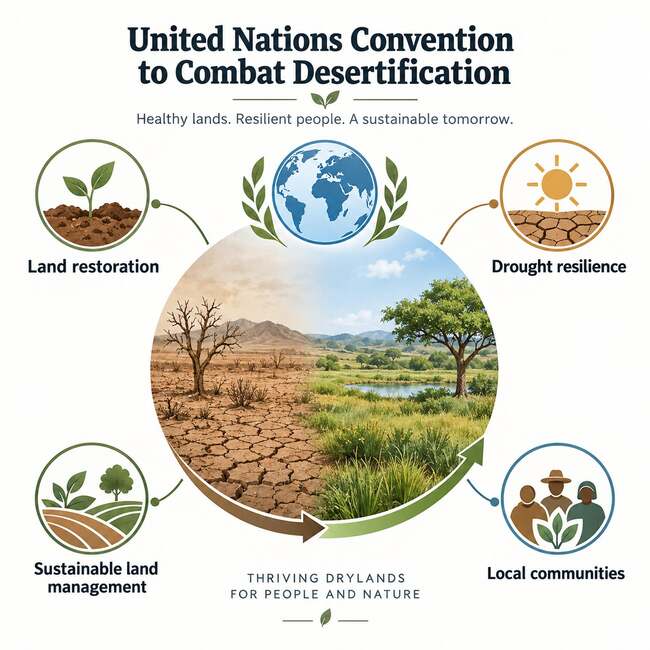
The United Nations Convention to Combat Desertification (UNCCD) is the only legally binding global agreement that addresses desertification, land degradation and drought. It links environmental protection with sustainable land management, food security and livelihoods.
Basic Details
- Genesis: The 1992 Rio Earth Summit called for a convention to address desertification, especially in Africa.
- Adoption: Parties adopted the Convention in Paris on 17 June 1994.
- Entry into force: It entered into force on 26 December 1996.
- Membership: It has 197 Parties, comprising 196 country Parties and the European Union.
- Secretariat: The UNCCD Secretariat is based in Bonn, Germany.
- Legal nature: It is a binding multilateral environmental agreement. Implementation mainly operates through national action programmes and COP decisions.
India and the UNCCD
- Signature and ratification: India signed the Convention on 14 October 1994 and deposited its instrument of ratification on 17 December 1996.
- National implementation: India uses its National Action Programme and land-restoration measures to address desertification and drought.
- Global role: India hosted UNCCD COP14 in New Delhi in 2019 and has promoted land-degradation neutrality.
Aims
- Combat desertification: Parties address land degradation in affected areas through long-term strategies.
- Mitigate drought effects: The Convention promotes preparedness, resilience and sustainable land and water management.
- Improve livelihoods: It seeks to protect food, water, shelter and economic opportunity in vulnerable landscapes.
Key Features and Institutions
- National Action Programmes: Affected Parties prepare nationally owned programmes with participation from local communities.
- Conference of the Parties: The COP is the supreme decision-making body. It reviews implementation and adopts decisions.
- Scientific support: The Committee on Science and Technology advises the COP on scientific and technical issues.
- Implementation review: The Committee for the Review of the Implementation of the Convention examines progress by Parties.
- Global Mechanism: It helps mobilise and channel finance for Convention implementation.
Significance
- Land-centred Rio Convention: The UNCCD complements the climate and biodiversity conventions by focusing on the land systems that support both.
- SDG linkage: It drives action towards SDG target 15.3 on land-degradation neutrality.
- Risk reduction: Better land management reduces drought risk, soil loss, food insecurity and distress migration.