
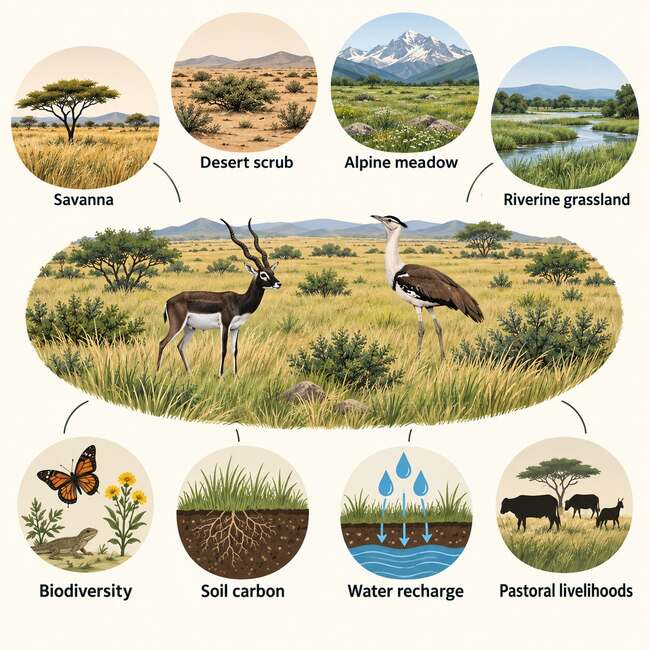
Grasslands and other open natural ecosystems are naturally tree-sparse landscapes shaped by rainfall, soil, fire, grazing and herbivores. They include grasslands, savannas, deserts, scrublands and rocky habitats, and they need conservation on their own ecological terms.
Basic Details
- Nature: They are natural open habitats. Low tree cover does not make them degraded land.
- Distribution: They occur across India’s arid, semi-arid, alpine, floodplain and coastal landscapes.
- Key drivers: Rainfall, soils, hydrology, fire, grazing and wildlife shape their structure and species composition.
Major Types
- Grasslands and savannas: These have continuous or patchy grass cover and scattered trees or shrubs.
- Dry open ecosystems: Deserts, scrublands and saline or rocky habitats support species adapted to heat, low rainfall and sparse vegetation.
- Specialised open habitats: Alpine meadows, riverine grasslands and coastal open areas depend on their local climate and water regime.
Characteristics and Ecological Role
- Open-habitat species: Their structure supports species that need visibility, grass cover or bare ground, such as the Great Indian Bustard, blackbuck, Indian wolf and floricans.
- Soil carbon: Deep grass roots can store carbon below ground and improve soil structure.
- Water regulation: Ground cover slows runoff, improves infiltration and reduces soil erosion.
- Pastoral systems: Many open landscapes support seasonal grazing, fodder and local livelihoods.
Major Threats
- Misclassification: Treating open ecosystems as wastelands can lead to unsuitable tree planting, land conversion or infrastructure expansion.
- Fragmentation: Roads, fencing, mines and dispersed development break habitat continuity for wide-ranging wildlife.
- Invasive plants: Woody and invasive species can alter grass cover, fire regimes and food availability.
- Unsuitable grazing control: Both overgrazing and complete exclusion of ecological grazing can damage habitats, depending on the ecosystem.
Conservation Priorities
- Ecosystem-specific management: Restoration must retain the natural openness, native grasses and hydrology of each landscape.
- Landscape protection: Conservation should include commons, revenue land and corridors, not only notified forests.
- Community participation: Pastoralists and local communities hold knowledge that can improve grazing and habitat management.