
The National Perspective Plan for Interlinking of Rivers (NPP) is the Union government’s framework for examining inter-basin water transfers in India. It identifies possible links; it does not by itself approve a dam, canal or diversion. Each link still needs technical studies, State agreements, statutory clearances and a workable operating regime.
Basic Details
- Formulated: 1980, as the National Perspective Plan for Water Resources Development.
- Technical agency: National Water Development Agency (NWDA), established in 1982 and entrusted with implementing the ILR programme.
- Scope: 30 identified links — 14 Himalayan and 16 Peninsular.
- Planning principle: Transfer is considered only after assessing availability in the donor basin and the needs of affected States and river reaches.
Components of the Plan
- Himalayan component: Covers proposed links in the Ganga–Brahmaputra system. Links such as Kosi–Mechi, Kosi–Ghaghra and Gandak–Ganga involve basins shared with Nepal, so storage and transfer require transboundary engagement as well as domestic consent.
- Peninsular component: Covers inter-basin transfers among rivers such as the Mahanadi, Godavari, Krishna, Pennar, Cauvery, Parbati, Kalisindh and Chambal. Its central challenge is agreement among the participating States.
- Priority links: The Government has prioritised the Ken–Betwa Link Project, the Modified Parbati–Kalisindh–Chambal Link Project, and the three Godavari–Cauvery sub-links.
How a Proposed Link Moves Forward
- Pre-Feasibility Report: Screens the broad route, potential transfer and likely benefits.
- Feasibility Report: Tests hydrology, engineering options, costs and the likely effects on affected basins.
- Detailed Project Report: Specifies design, alternatives, environmental management, land acquisition, rehabilitation and State-level arrangements.
- Agreement and implementation: A link proceeds only when financing, statutory approvals, State concurrence and operational rules are in place.
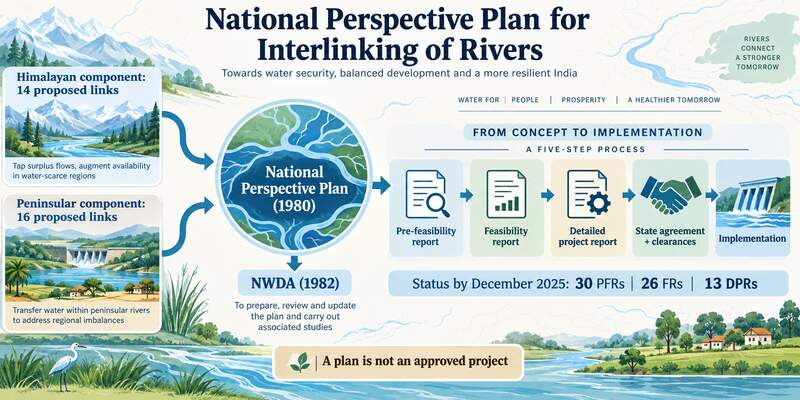
As of December 2025, NWDA had completed Pre-Feasibility Reports for all 30 links, Feasibility Reports for 26, and Detailed Project Reports for 13. This progression shows why the NPP is a long-horizon planning framework, not a completed national water grid.
Current Implementation Status
- Ken–Betwa Link Project: The only NPP priority project in implementation. It transfers water from the Ken to the Betwa for the Bundelkhand region of Madhya Pradesh and Uttar Pradesh.
- Other links: The Modified PKC project is under appraisal after agreements among Madhya Pradesh, Rajasthan and the Union. NWDA has prepared technical and draft implementation material for the Godavari–Cauvery proposal.
- Dynamic water availability: The Netravati–Hemavati proposal shows why each link requires fresh assessment: the Ministry of Jal Shakti states that further studies stopped after the Yettinahole project left no surplus water in the Netravati basin for diversion.
Why the NPP Matters for UPSC
- Water-security framework: It addresses uneven spatial and seasonal distribution of water, but cannot treat a basin’s “surplus” as permanent.
- Federal governance test: Water is primarily a State subject, while inter-State rivers require Union coordination; State consensus remains the main implementation constraint.
- Environmental test: Every proposed link must protect ecological flows, wetlands, forests, wildlife and downstream livelihoods; an Environmental Impact Assessment during feasibility and DPR preparation is therefore central, not procedural.
- Project-versus-plan distinction: The NPP is the umbrella framework. A specific project such as Ken–Betwa has its own design, clearances, affected families, costs and performance outcomes.
Sources: Ministry of Jal Shakti, July 2025; Department of Water Resources, December 2025; NWDA.