
The Supreme Court is hearing a plea on using totaliser machines with Electronic Voting Machines (EVMs). The Centre and the Election Commission of India oppose the proposal. They argue that it may weaken booth-wise counting. They also question whether it gives a clear gain in ballot secrecy.
What the petition seeks to protect
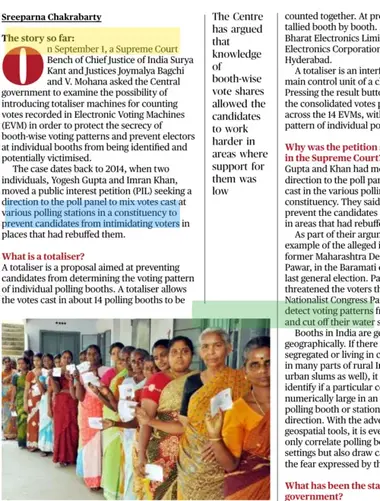
The case begins with a real concern: voters may face pressure when political actors can infer the voting pattern of a small locality. A totaliser seeks to make that inference harder by combining votes before counting them.
- Combined result: A totaliser pools votes from about 14 polling booths before declaring a result. It does not show the outcome of each booth separately.
- Local vulnerability: The petitioners argue that booth-level results can expose communities to intimidation or discrimination after an election.
- Past request: In 2014, voters sought a public-interest direction to mix votes from different booths before counting.
- Secrecy objective: The proposed mechanism tries to protect the voter’s secret choice, especially where social groups live in identifiable clusters.
Why the Centre and the Election Commission disagree
The government does not deny the value of ballot secrecy. Its objection is that a booth result is not an individual vote, and that aggregating results may reduce useful local electoral accountability.
- Individual secrecy: The Centre says a booth-wise result does not reveal how any particular voter cast a ballot.
- Electoral feedback: The Election Commission says booth-level results help candidates identify areas where they have low support and engage with voters there.
- Parliamentary decision: The government says Parliament has considered but not adopted the totaliser proposal.
- Judicial question: The Supreme Court has asked whether totalisation may be justified if it protects voters from coercion and intimidation.
What the case tests in election administration
The issue requires a balance between two public values. Election administration must protect voters from pressure while preserving transparent and trusted counting procedures.
- Secret ballot: Protection is meaningful only when voters can make choices without fear of later social or political consequences.
- Transparent counting: Any change must retain public confidence that votes are counted accurately and that results remain verifiable.
- Proportionate reform: The Court will need to assess whether the privacy benefit is strong enough to justify changing the present booth-wise system.
- Institutional role: The case also tests how far courts should direct electoral design when Parliament and the Election Commission have taken a different view.
Mains Angle
GS 2: Electoral reforms. Practice question: Examine the tension between secrecy of the ballot and transparency in election administration.
Source: The Hindu