
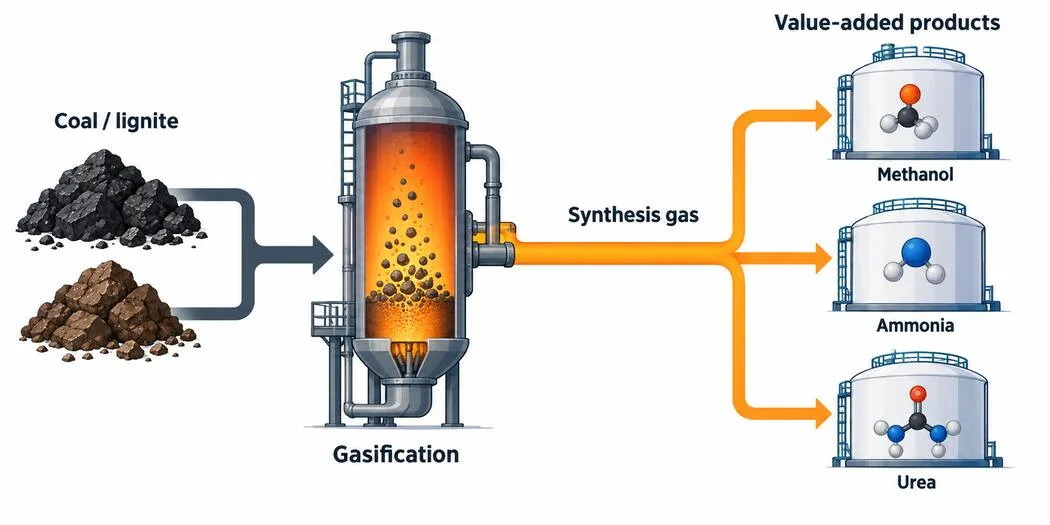
The Scheme for Promotion of Surface Coal/Lignite Gasification Projects is a Union financial-incentive scheme for new plants that convert coal or lignite into synthesis gas (syngas) and useful industrial products.
Basic Details
- Nodal ministry: Ministry of Coal.
- Approved: 13 May 2026.
- Type: Competitive Union financial-incentive scheme.
- Beneficiaries: Selected developers of eligible new gasification projects; detailed eligibility is outlined below.
- Outlay and period: ₹37,500 crore, implemented over 2026–27 to 2032–33.
- Target: Support gasification of about 75 million tonnes of coal or lignite, contributing to India's 100-million-tonne national target by 2030.
Aim and Objectives
- Value addition: Convert domestic coal and lignite into syngas and higher-value industrial feedstocks.
- Import substitution: Build domestic supply options for selected fuels, fertiliser inputs and chemicals.
- Commercial deployment: Encourage large-scale gasification projects and contribute to the national coal-gasification target.
- Technology and regional investment: Build a domestic technology ecosystem and encourage industrial investment in coal-bearing regions.
Key Features
- Surface gasification: Coal or lignite reacts above ground with controlled oxygen and steam—not by complete burning—to form syngas, mainly carbon monoxide and hydrogen. “Surface” refers to the plant location; underground coal gasification occurs within a coal seam.
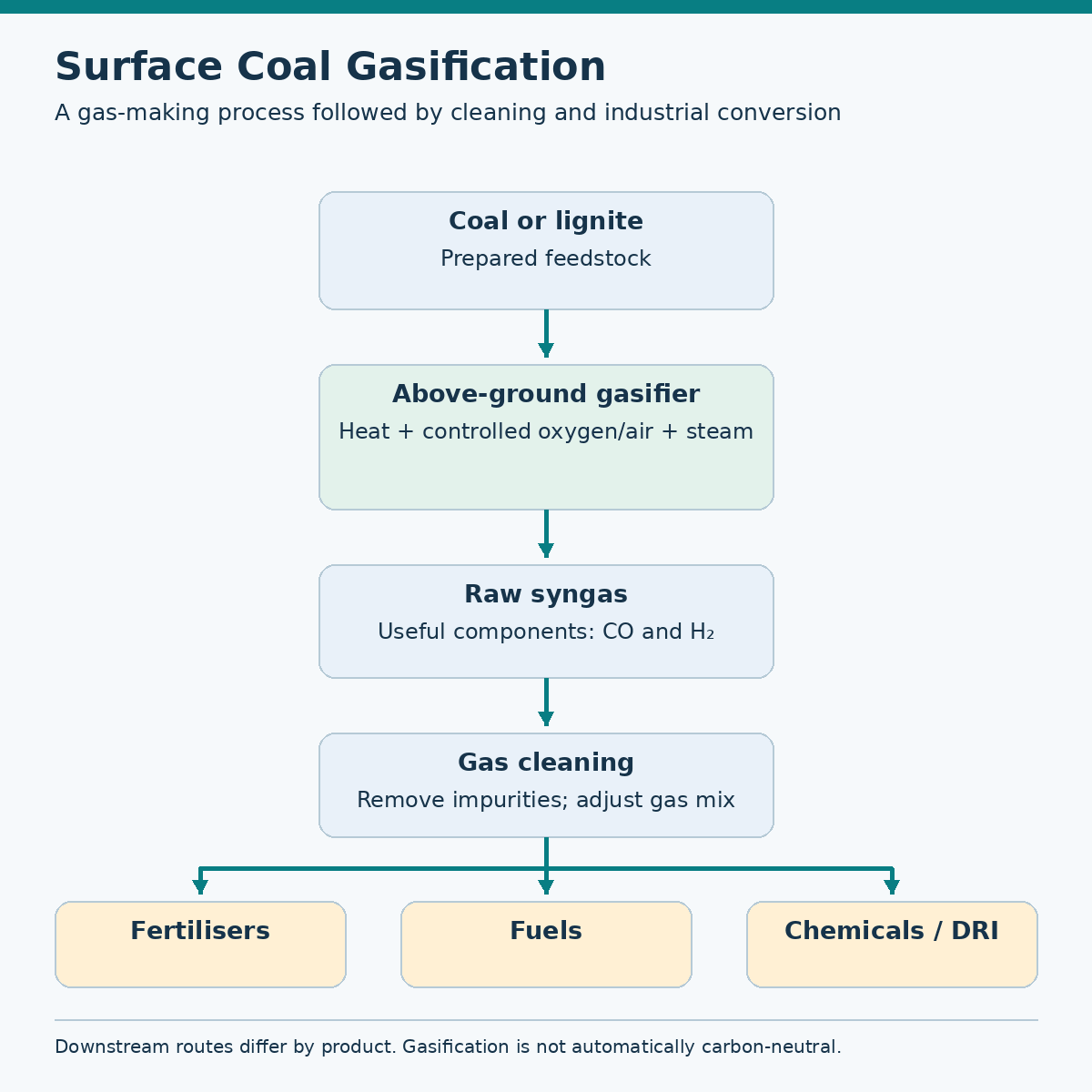
- Products: Syngas can be used as a fuel or converted into products such as ammonia, urea, methanol, hydrogen, synthetic natural gas and direct-reduced iron (DRI).
- Eligible projects: New projects by public-sector undertakings, private companies, joint ventures or consortia. Each project must have at least 0.5 million tonnes per annum (MTPA) of clean-syngas capacity; an applicant's net worth must exceed 20% of project cost.
- Capital incentive: Selected projects may receive up to 20% of eligible plant-and-machinery cost, subject to a maximum of ₹5,000 crore per project. The actual award depends on competitive selection; it is not an automatic grant of the maximum.
- Competitive selection: The Ministry selects projects through Requests for Proposal, comparing the incentive sought, scale and efficiency, technology arrangement and applicant's financial strength. The scheme is technology-agnostic and encourages indigenous technology.
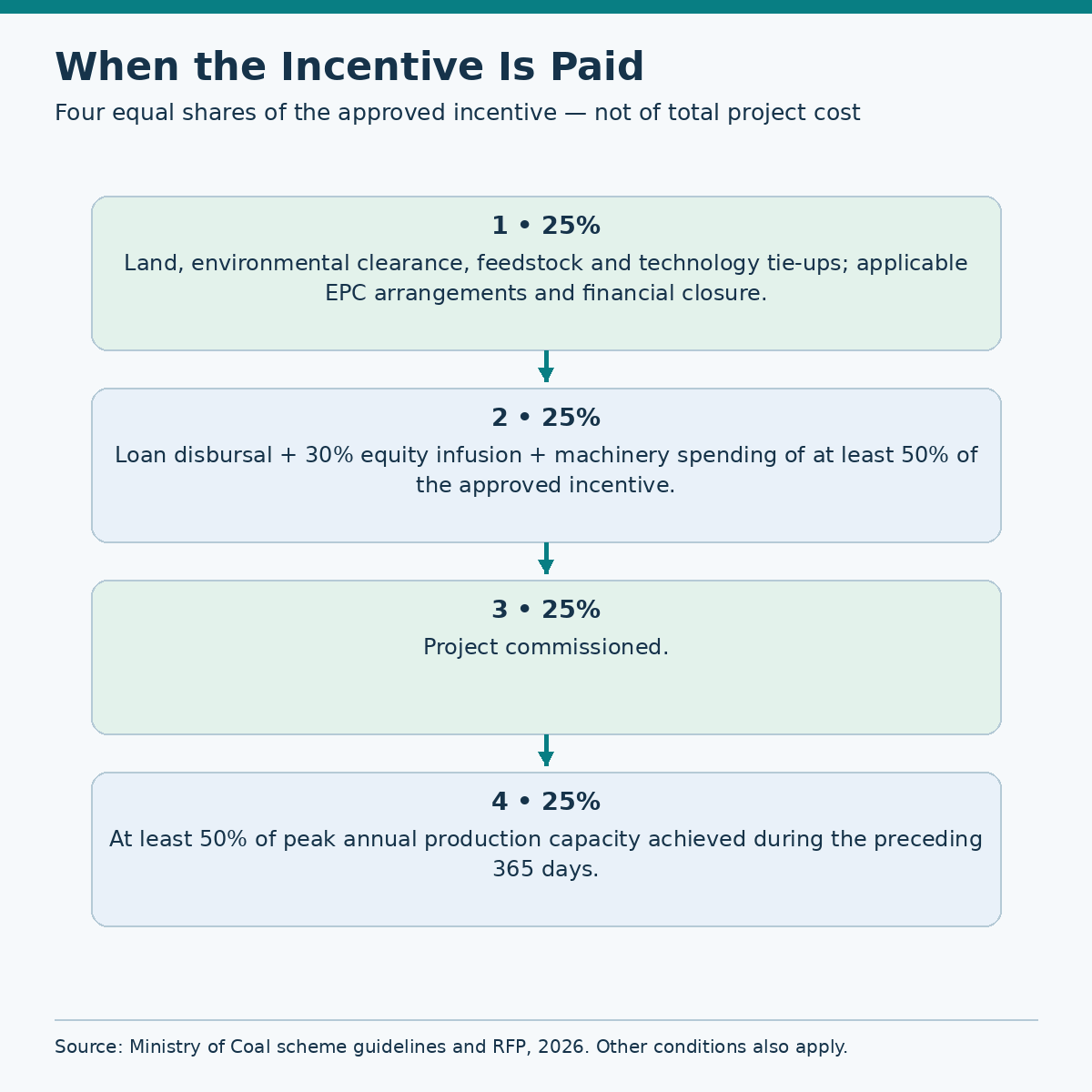
- Milestone-based release: The incentive is divided into four equal instalments tied to project readiness, investment, commissioning and production.
- Market responsibility: The project developer arranges buyers or downstream use; the scheme does not guarantee a market for the outputs.
Significance
- Industrial security: Domestic syngas and chemical feedstocks can diversify supply and reduce exposure to selected imports.
- Value from coal: Gasification creates a route to use coal and lignite as industrial feedstocks, not only as fuels for direct combustion.
- Environmental limit: Gasification is not renewable or carbon-free. Its emissions and water impacts depend on plant efficiency, pollution controls, coal source and whether carbon capture is used.