
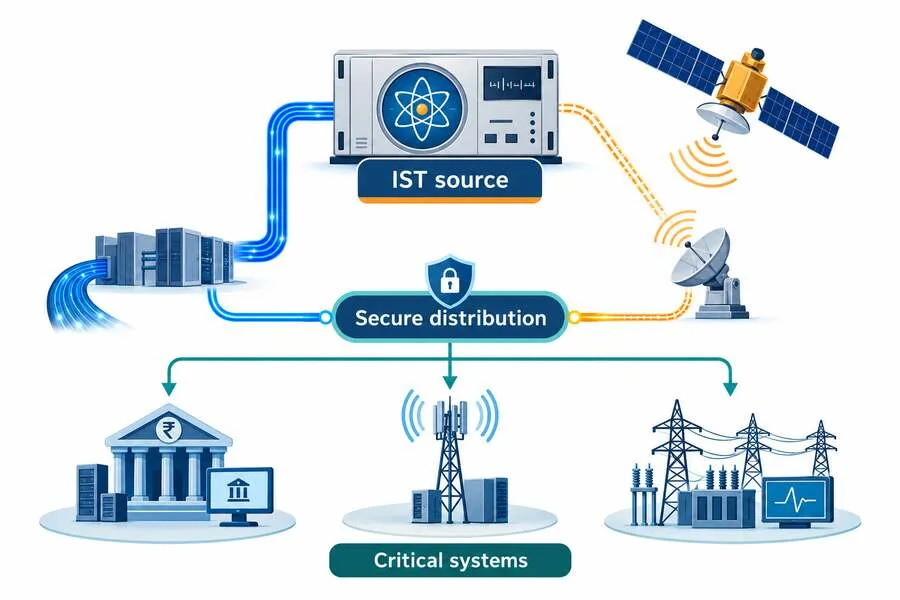
One Nation, One Time is India’s initiative to make Indian Standard Time (IST) the common, legally recognised and traceable reference for official and critical digital systems. It is not a proposal for a new time zone; India continues to use IST, which is UTC+5:30.
Basic Details
- Legal framework: Legal Metrology (Indian Standard Time) Rules, 2026.
- Notified: 27 August 2026; the Rules take effect 180 days after publication in the Official Gazette.
- Lead institutions: Department of Consumer Affairs and the National Physical Laboratory (NPL).
- National time: Indian Standard Time (IST), the official time reference for India.
Key Features
- Legally recognised time reference: The Rules establish IST as the reference for official use and for systems where timing accuracy has legal, financial or safety consequences.
- Atomic-clock traceability: NPL maintains India’s standard time using atomic clocks, providing a precise national reference rather than relying only on external time feeds.
- Secure time distribution: NavIC and approved Indian timing sources can distribute traceable IST to users and critical networks.
- High-precision network synchronisation: The White Rabbit demonstration network at NPL’s Regional Reference Standard Laboratory, Bengaluru, shows how precise time can be distributed across digital systems.
- Critical-sector focus: Banking, telecommunications, power grids, transport and digital networks depend on synchronised time for secure transactions, sequencing and fault analysis.
Significance
- Financial integrity: A common traceable time stamp strengthens the ordering and audit trail of high-volume digital transactions.
- Cyber resilience: Accurate time helps correlate logs, detect anomalies and investigate cyber incidents across different systems.
- Infrastructure reliability: Power-grid and telecom networks need synchronisation to coordinate operations and locate faults quickly.
- Strategic autonomy: A nationally maintained, traceable time infrastructure reduces dependence on foreign timing sources for critical services.
Source: Press Information Bureau; National Physical Laboratory